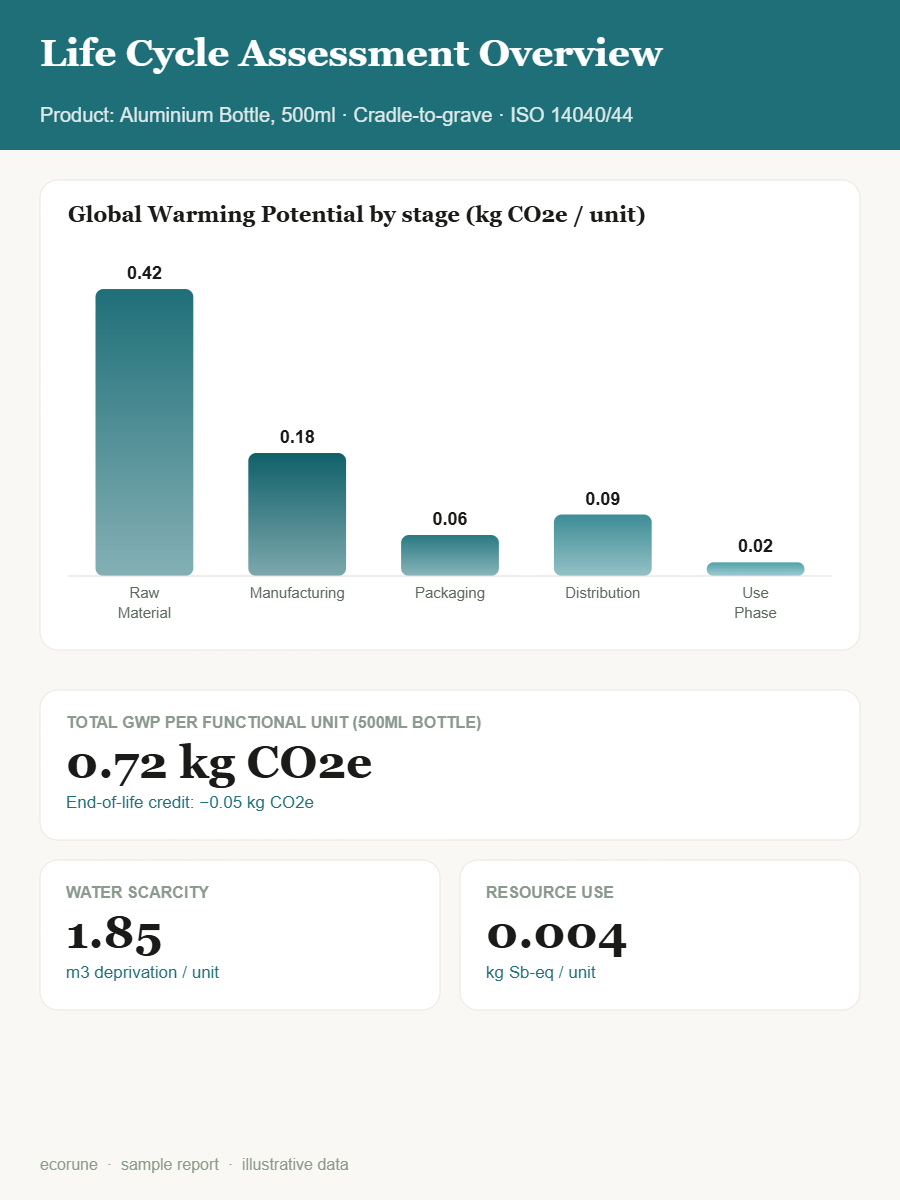
Every product has an environmental story. Long before it reaches your customer, it has consumed raw materials, energy, water and land, and generated emissions across a complex network of suppliers, manufacturers, transport and end of life processes. Life Cycle Assessment (LCA) allows you to understand that story.
Whether you are developing a new product, preparing an Environmental Product Declaration (EPD), quantifying a Product Carbon Footprint (PCF), or meeting customer and regulatory requirements, we provide scientifically robust assessments that support confident decision making.
A well executed Life Cycle Assessment doesn't simply calculate impacts, it explains why they occur, where they originate, and how they can be reduced. It answers questions such as:
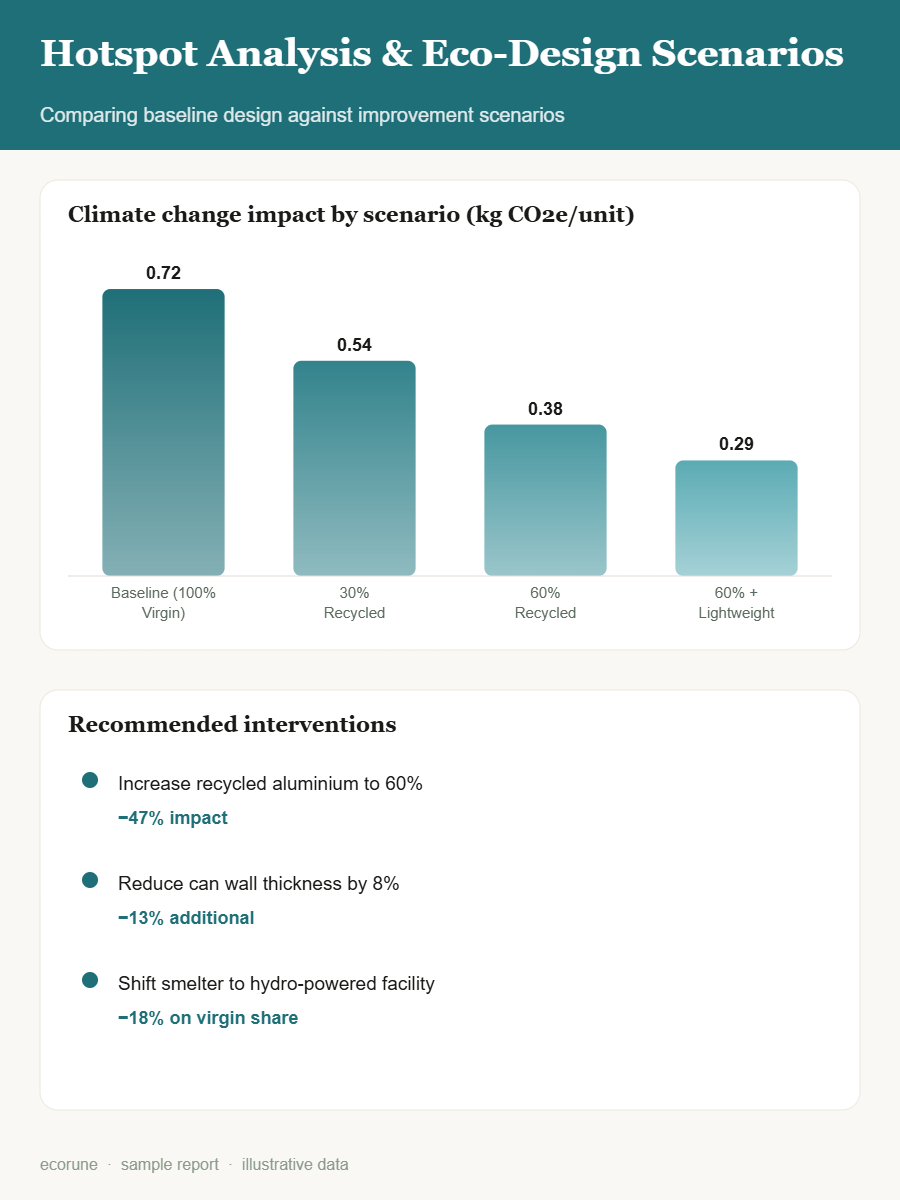
Which material contributes most to climate change?Does recycled content actually reduce impacts?Should manufacturing be relocated?Would a different supplier improve environmental performance?Does lightweight packaging reduce impacts, or shift them elsewhere?Which design changes create the greatest environmental benefit?
What is a functional unit? Every LCA is anchored to a functional unit, the quantified performance of a product system that makes results comparable. It captures not just an amount of product, but the function it delivers: for example, not "one bottle" but "storing and delivering 1 litre of beverage to the consumer, ready for consumption." A well defined functional unit ensures that alternatives are compared on equal terms, same performance, same reference flow, so the results reflect real environmental trade-offs rather than an unfair comparison.
Our approach
One of the biggest mistakes organisations make is optimising only one part of a product's life cycle. Reducing packaging weight might increase food waste; switching materials may reduce carbon emissions while increasing water consumption. Every decision creates consequences, and LCA helps reveal these trade offs before they become expensive mistakes.
Not every LCA answers the same question. Attributional LCA describes environmental impacts as they exist today, using average suppliers and standard allocation rules to share impacts across co-products, useful for EPDs, PCFs and reporting.
Consequential LCA instead follows the cause and effect chain: what happens if demand for the functional unit changes? It models the marginal suppliers most likely to respond to that change and uses substitution rather than allocation to handle co-products, making it the right tool for redesign decisions, material substitution and future scenario planning. We are equipped to carry out both approaches, and help you choose the one that answers the actual question behind your decision.
What we help you with
Goal and scope definitionLife cycle inventory (LCI)Life cycle impact assessment (LCIA)Attributional or consequential modellingInterpretation and critical review
Goal and scope definitionData collection and LCA modellingPCR interpretationThird party verification supportPublication readiness
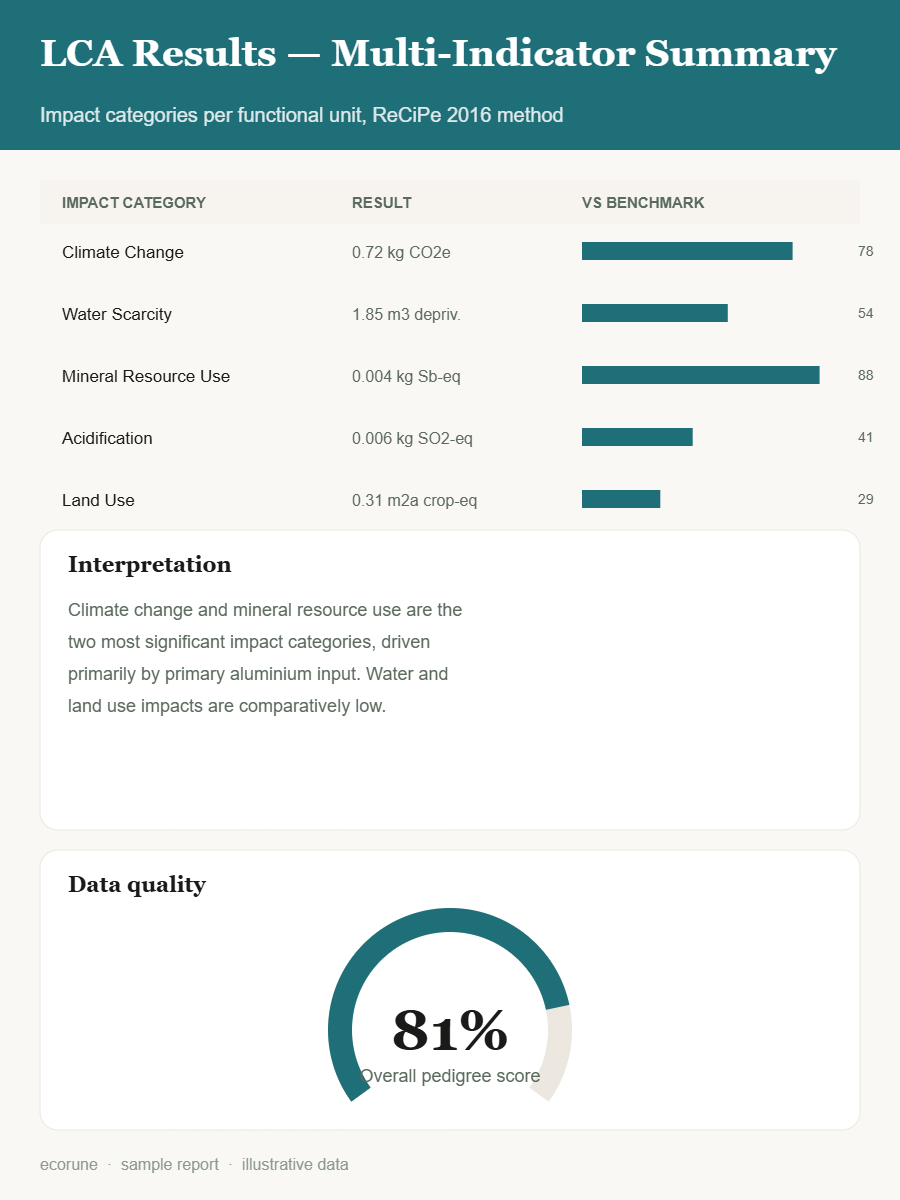
Resource depletionWater consumptionLand useEcotoxicityBiodiversity related indicators
Material selectionManufacturing improvementsRecyclability and durabilityCircular economy strategiesIndependent LCA review
Standards and methodologies
ISO 14040ISO 14044ISO 14067ISO 14025EN 15804PEFProduct Category Rules (PCRs)GHG Protocol Product Standard
Why ecorune
Environmental impact assessment is our speciality
Many consultancies expanded into sustainability because the market demands it. This has always been our focus, built on environmental engineering, life cycle assessment, carbon accounting and systems thinking.
We believe in scientific honesty
Every environmental model contains uncertainty. Rather than hiding assumptions or presenting false precision, we document uncertainties and communicate results transparently.
Technical depth with business relevance
An LCA should never end as a technical report that sits on a shelf. Every assessment should help someone make a better decision.
We never stop learning
New databases, better emission factors and improving standards mean we keep learning. We promise curiosity, continuous learning and technical excellence.
Both are valid, and we can carry out either. Industry practice mostly follows attributional LCA, since it suits reporting, declarations and describing an existing system. But if the goal is to actually improve a product, factoring in market mechanisms and modelling future scenarios, we recommend consequential modelling. Neither is universally right or wrong; the choice remains a heavily debated topic in industrial ecology, and we help you pick the one that fits your decision.
Yes. We support the complete process, from data collection and LCA modelling through documentation, verification support and publication readiness.
We work with recognised professional LCA tools such as openLCA, and are also proficient with SimaPro and Brightway. We use both process based and input-output databases, such as ecoinvent and EXIOBASE, selecting the combination most appropriate for the project.
Yes. We perform critical reviews, update studies with improved data, expand system boundaries, or prepare assessments for independent verification.
Understand your product’s true impact
Whether you're developing a new product, preparing an EPD, quantifying a PCF, or exploring the consequences of future design decisions, we provide the scientific expertise and practical guidance to help you move forward with confidence.